
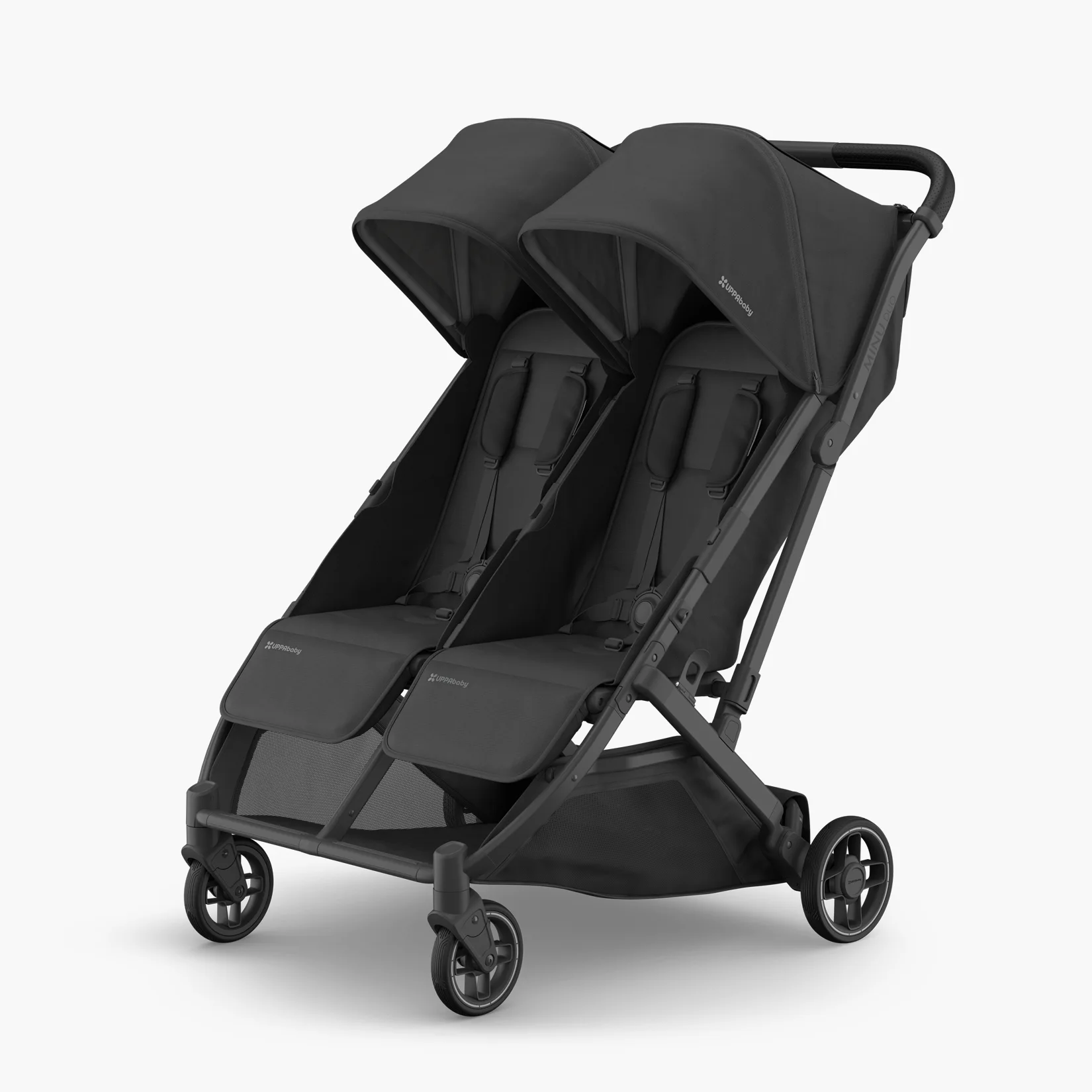
The Minu Duo is UPPAbaby’s compact side-by-side, suitable from birth, listed at $1,149. It exists for one buyer: you have two children, or you are about to, and you are not prepared to give up the front door or the supermarket aisle to a pram that will not fit through them. On the manufacturer’s figures it clears a standard 73 cm doorway and carries children up to 22.7 kg.
All prices here are as at 30 July 2026, lowest listed Australian retail.
The case for it
The width is the whole argument, and it is a better argument than it sounds. Most doubles in this field solve two children by getting wider, longer, or both, and then hand you the consequences at every kerb and doorway for the next four years. UPPAbaby’s answer is a side-by-side built to a published 73 cm, the figure the maker gives for a standard doorway. If you live in an apartment or do the school run through a shopping centre, that number decides more of your daily experience than any fabric claim on the same spec sheet.
The second point in its favour is that it is a double from birth. Both seats take a newborn, so you are not buying a pram now and a second solution in six months. The harnesses are five-point and no-rethread, and UPPAbaby specifies them as optimised for infants with a narrower shoulder fit that widens as the child grows. That is a real distinction in a segment where “suitable for two” often means one seat from birth and one from six months, and where the newborn kit is a separate line on the invoice. The Thule Urban Glide 3 Double at $1,599 is seats-from-six-months unless you add a bassinet or capsule adapters, and those are sold separately.
The fold is the third. One hand, one step, with a locking latch, and an integrated crossbar carry handle so you can lift the folded pram in one movement rather than wrestling it by a wheel. It takes 8.5 on our fold and footprint sub-score, the highest of any double assessed here, ahead of the Mountain Buggy Duet V4 at 7.5 and the Thule Urban Glide 3 Double at 7.5. For a two-child pram that is unusual. Doubles normally trade fold quality away to get the seats in, and this one does not.
The detail work is sensible rather than showy. Canopies are UPF 50+, water-repellent, zip-out and extendable, which is the right specification for a Queensland summer and a Melbourne winter alike. The recline is one-handed and deep. There is a hidden pocket sized for a tracker tag, which sounds like a marketing line until the pram goes into an airport hold. Conversion and versatility scores 8.0, reflecting a frame that adapts to twins or to a newborn and a toddler without a different product.
The case against it
Push and wheels is the weak column, at 7.0. That is the lowest number on the Minu Duo’s own card, and the two doubles it most needs to beat go the other way: the Duet V4 takes 9.0 and the Thule Urban Glide 3 Double takes 9.5 on the same measure. Doubles are heavy by definition, and the weight has to go through the wheels every time you turn one on a footpath or lever it up a gutter. A running-gear compromise is manageable on smooth surfaces and a tiring one on grass or a sloping nature strip. If your walks are park loops rather than pavement, this is the sub-score to weigh.
The published specification is also thinner than it should be at this money. Our data pack carries no folded dimensions for the Minu Duo, no folded or unfolded weight, and no basket capacity. For a pram sold on being compact and travel-friendly, the absence of a folded measurement is a strange gap. You cannot check on paper whether it clears your boot lip, and you cannot compare it to the numbers its rivals do publish. The Bugaboo Dragonfly publishes 36 x 52 x 90 cm and 9.9 kg. The Joolz Aer2 publishes 6.5 kg and a 44 x 53 x 23.5 cm fold that meets IATA carry-on rules. UPPAbaby leaves you to find a shop floor and lift it, which you should do before you commit, ideally while holding a child.
There is no suspension specified either. The Vista V3 at $1,499 lists all-wheel suspension and the Cruz V3 at $999 lists FlexRide suspension, both from the same brand. Nothing equivalent appears on the Minu Duo’s published features. It may be there. It is not published, and on a specification assessment an unpublished feature counts for nothing.
Australian parts and service sits at 7.5, which is mid-field. Babyhood takes 9.0 on that measure and Babybee 8.5, both Australian operations with local parts support. A double gets folded and knocked about roughly twice as hard as a single, and the question of how quickly a replacement wheel or fold latch reaches you matters more here than on a pram carrying one child.
Finally, watch the listings. The same pram appears at $1,149 in one retailer’s Australian catalogue and at $1,199 in another as the Minu Duo in Jake. That is $50 for a colourway, which is your call, but read the inclusions line before the price line.
How it compares
Mountain Buggy Duet V4 Double Pram, $1,259. Bench Score 8.2, Best double. This is the pram the Minu Duo has to beat, and on our scores it does not. The Duet V4 is $110 dearer and takes the field’s Best double award for a specific reason: it puts a genuine all-terrain double on the same wheelbase width as a single buggy, running air-filled tyres and a 6060 T52 aircraft-grade aluminium frame, with newborn-to-upright sling seats and a one-hand standing fold. It beats the Minu Duo on push and wheels 9.0 to 7.0, on build and materials 8.5 to 8.0, and on Australian parts and service 8.0 to 7.5. The Minu Duo takes the fold, 8.5 to 7.5. If your two children will spend time on anything rougher than a footpath, the extra $110 is the easiest money in this comparison.
Thule Urban Glide 3 Double Stroller Black, $1,599. Bench Score 7.8. Level on the Bench Score, $450 dearer, and a completely different proposition. Thule’s running gear is the best on paper in the whole field, with large air-filled tyres and a suspension system, and it scores 9.5 for push and wheels against the Minu Duo’s 7.0. Thule publishes capacity at 22 kg per seat and 44 kg combined. The catch is the front of the child’s life rather than the back: seats are six months and up, and newborn use requires a bassinet or capsule adapters at extra cost, which is why conversion and versatility falls to 6.5 against the Minu Duo’s 8.0. Buy the Thule if you run trails and your children are past the newborn stage. Buy the Minu Duo if you need both seats working from the hospital carpark.
Valco Baby Snap Ultra Duo Stroller, $769. Bench Score 7.4. The Australian undercut, and $380 cheaper. It is a newborn-suitable side-by-side with removable, reversible seats that can face you, face out, or split one of each, plus shock-absorbing suspension, a full recline, travel-system compatibility and an integrated carry strap. Conversion and versatility matches the Minu Duo at 8.0, and Australian parts and service beats it at 8.5. Where it gives ground is build and materials, 6.5 against 8.0, and fold and footprint, 7.0 against 8.5. You are paying UPPAbaby $380 for a better fold and a better-made frame. If the budget is the binding constraint, the Valco does the job for less and leaves you money for the capsule.
Worth naming for the buyer who wants Australian backing is Babyhood’s Doppio Plus. The single is $1,499 and scores 8.1; a usable double is $2,128.95 after adding the required adaptor to the $1,999 package. Babyhood publishes a 62 × 80 × 51 cm single-seat fold, foam-core wheels and independent suspension, with the field’s best Australian parts and service score at 9.0. The Minu Duo remains the more compact dedicated double at 8.5 for fold and footprint; the Doppio is the more flexible one-to-two-child platform.
Verdict
The Minu Duo is a narrow answer to a narrow question, and it answers it well. If two children have to fit through a 73 cm doorway from birth, and if the pram has to fold in one hand and be carried by one handle, nothing else assessed here does it as neatly. That is the case, and it is enough of a case to justify $1,149 for the right household.
It is not the best double in this field, and we are not going to pretend otherwise. The Mountain Buggy Duet V4 is $110 more and better where doubles are hardest, which is the running gear, and it holds the Best double award. The Minu Duo’s 7.0 for push and wheels is a real limit rather than a rounding error, and the missing folded dimensions, folded weight and basket capacity make a compactness claim you have to take on trust. Take it on trust only after you have lifted one.
| Sub-score | |
|---|---|
| Conversion and versatility | 8.0 |
| Fold and footprint | 8.5 |
| Push and wheels | 7.0 |
| Build and materials | 8.0 |
| Australian parts and service | 7.5 |
Bench Score: 7.8. UPPAbaby Minu Duo Stroller, $1,149. No award.
Assessed on specification, 30 July 2026.
Disclosure: Babyhood is an agency client of The Baby Bench’s publisher, Xpand Digital. Scores and rankings are set from the published specification and are not influenced by that relationship. The Best double award in this category is not a Babyhood product.
Evidence record
Sources checked
Product specifications, claims and Australian pricing were checked against the following sources for this assessment. Prices and availability can change after publication.