
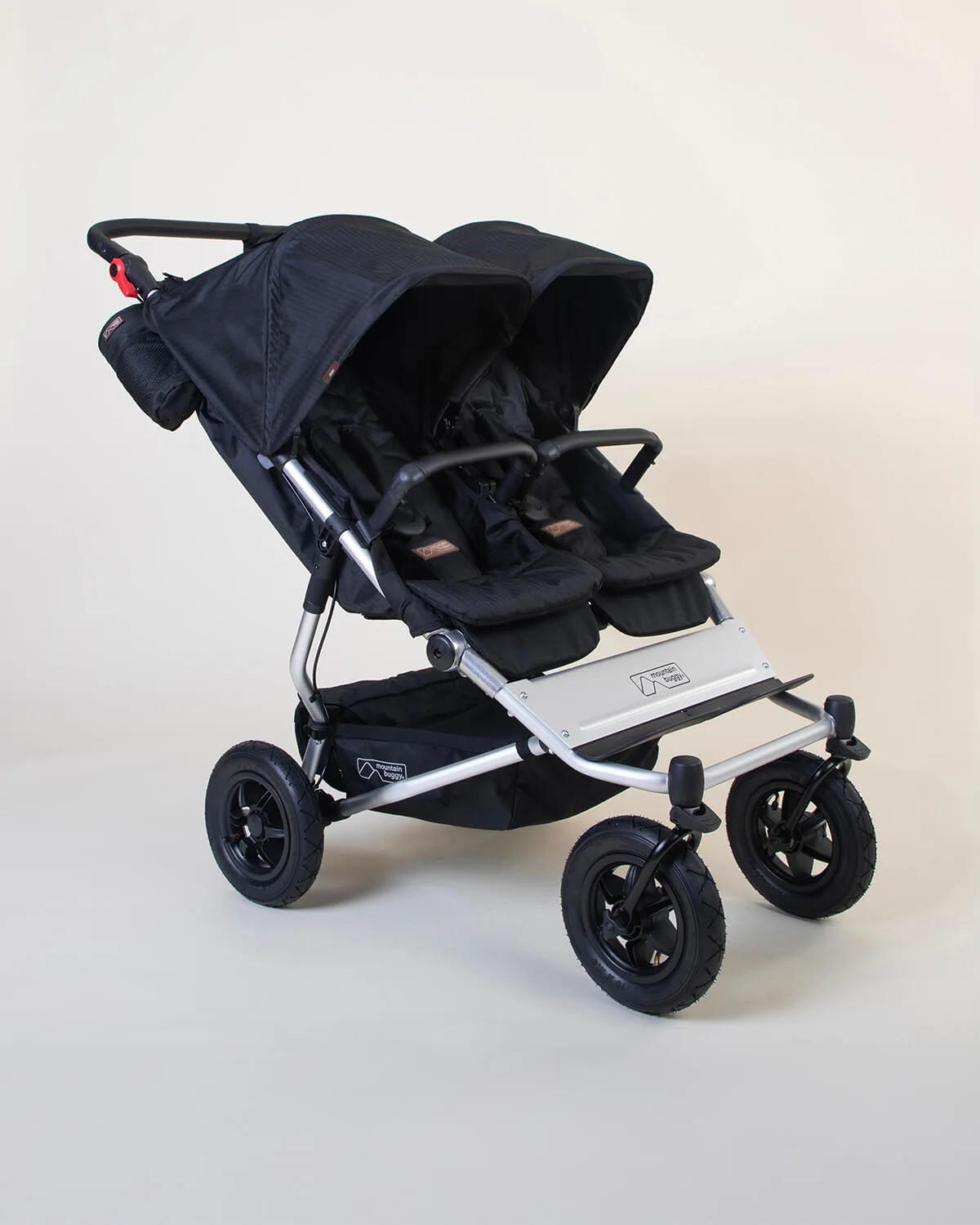
The Duet V4 is Mountain Buggy’s side-by-side double, and at $1,259 it is the cheapest genuinely all-terrain double in this field. It carries two children on a frame the maker says is the same wheelbase width as a single buggy, on air-filled tyres, with fabric sling seats that run from newborn recline to upright. Buy it if the pram has to work on grass and gravel with two on board. Do not buy it expecting the spec sheet to answer your questions, because Mountain Buggy publishes far more about the frame than it does about the numbers. Prices here are as at 30 July 2026, lowest listed Australian retail, and this assessment is on the manufacturer’s published specification only.
The case for it
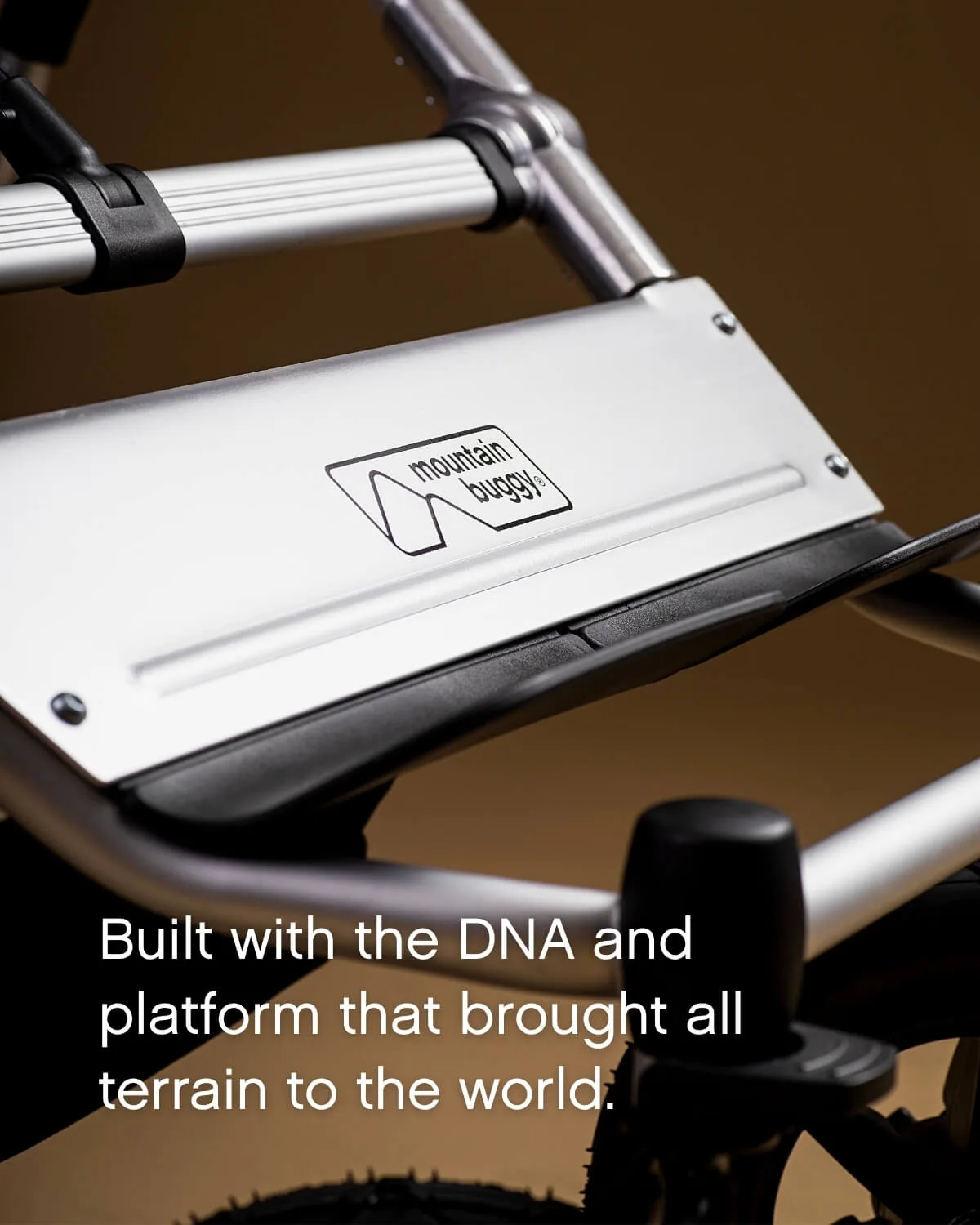
The argument starts with the running gear. Mountain Buggy lists air-filled tyres and describes the Duet as a true all-terrain buggy built on the platform that put the brand in the category. We score it 9.0 for push and wheels, and the only prams above it in the entire field are the two Thule Urban Glide 3 models, single and double, which run 16 inch air-filled tyres with rear suspension and score 9.5. Every other double sits below the Duet on that measure, including the Bugaboo Donkey 5 Twin at 8.5 and the UPPAbaby Minu Duo at 7.0.
That matters more with two children than with one. A double carries roughly twice the load through the same set of wheels, and on a footpath edge or a patch of park grass the difference between an air tyre and a moulded urban wheel is the difference between a pram you steer and a pram you shove. Mountain Buggy’s own language for this is kerb pop, which is marketing, but the tyre specification underneath it is not.
The frame is 6060 T52 aircraft-grade aluminium, the same material Mountain Buggy quotes for the Swift V4 single at $729. We score the Duet 8.5 for build and materials, level with Bugaboo’s Donkey 5 Twin and the Thule Urban Glide 3 Double, and above the Babybee Juno at 8.0. Fabrics are listed as herringbone with vegan leather accents, so the cabin is not obviously cheapened to hit the price.
The seats are the quiet win. Mountain Buggy specifies newborn-to-upright sling seats with a recline and upright mechanism, which means the Duet is usable with a small baby out of the box. Compare that with the Thule Urban Glide 3 Double at $1,599, where both seats are rated from six months and newborn use requires a bassinet or capsule adapters bought separately. You are paying $340 less for the Duet and starting earlier.
Round it out with the details Mountain Buggy does publish: UPF 50+ follow-the-sun canopies and a patented tail-free safety harness. Australian parts and service scores 8.0, which puts the Duet above Bugaboo and UPPAbaby at 7.5 and well above Thule at 7.0. It sits behind Babyhood at 9.0 and behind Babybee and Valco Baby at 8.5, but for an imported brand that is a strong position, and it is the kind of thing you only think about on the day a wheel needs replacing.
The case against it
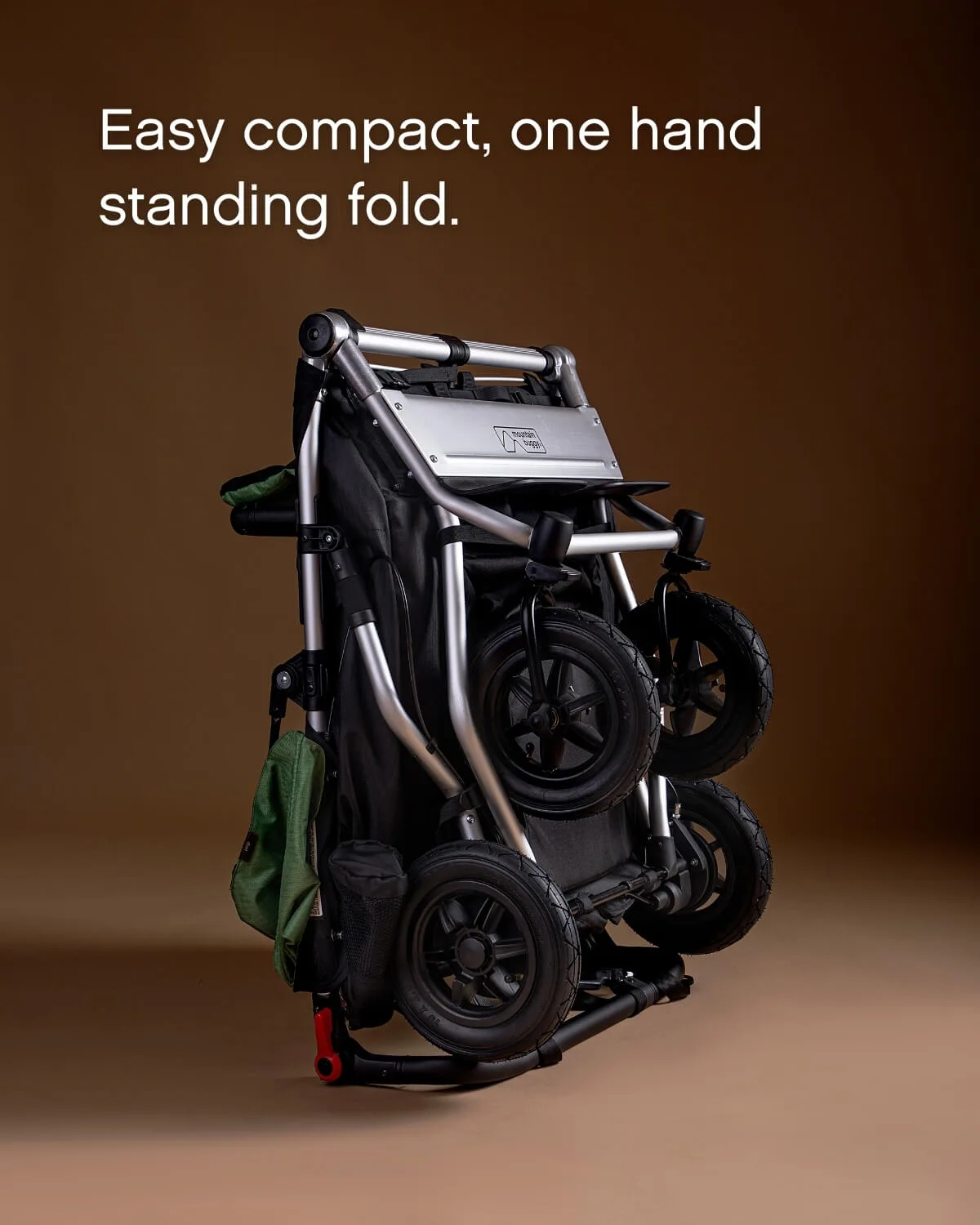
The first problem is what is missing. Mountain Buggy does not publish a pram weight for the Duet, does not publish folded dimensions, does not publish a per-seat weight limit, and does not publish a basket capacity. “Easy compact, one hand standing fold” is a claim without a measurement attached to it, and “the same wheelbase width as a single buggy” is a comparison rather than a number in centimetres.
Rivals do better. UPPAbaby states that the Minu Duo fits a standard 73 cm doorway and takes children to 22.7 kg. Bugaboo publishes 22 kg per seat and a 10 kg basket for the Donkey 5 Twin. Thule publishes 22 kg per seat and 44 kg combined for the Urban Glide 3 Double. If you are buying a double around a hallway, a boot or a lift, those figures decide the purchase, and the Duet asks you to take them on trust. We score fold and footprint at 7.5, and the absent measurements are most of the reason it is not higher.
Second, the Duet is a double and stays a double. Conversion and versatility scores 8.0, which is the lowest of the strong performers in this category. The Bugaboo Donkey 5 and Donkey 6 convert between single and side-by-side in three clicks and score 9.0 and 9.5 for it. The UPPAbaby Vista V3 runs from one child to three with a RumbleSeat and a PiggyBack and scores 9.5. Mountain Buggy says the Duet is adaptable for siblings or twins, which covers the two-child cases well enough, but there is no published trick that turns it back into a single when the older child stops riding. That is a real cost over four years.
Third, the seats are slings, and the published specification does not list a bassinet in the box. The Donkey 5 Twin at $1,889 includes two bassinets and two reversible seats. That is $630 more, and the price gap is roughly what two bassinets are worth, so this is a fair trade rather than a defect. It is still the thing to check before you buy if you want a flat, enclosed newborn bed rather than a reclined sling.
Fourth, air-filled tyres cut both ways. They give the Duet its 9.0 push score, and they are also the tyres you will be pumping up in a carpark in three years. Mountain Buggy’s own Swift V4 runs puncture-proof 10 inch aerotech tyres, and Bugaboo fits puncture-proof wheels to the Donkey 5. Neither rides as well as air. Both remove a job from your life. Decide which one you would rather have.
One note on pricing. The $1,259 figure is the Duet V4 at Baby Village. The Heritage Collection Solare colourway lists at $1,299.99, so the fabric choice costs you $40.99. There is also a single ex-display Duet listed at $899.99 through a Brisbane store, which is a one-off unit and not a price you should expect to find generally.
How it compares
Thule Urban Glide 3 Double Stroller, $1,599. The Duet’s closest rival on intent and its superior on running gear. Thule publishes 16 inch air-filled tyres, a suspension system, a lockable swivel front wheel and an integrated twist hand brake, and it scores 9.5 for push and wheels against the Duet V4’s 9.0. It also publishes the numbers the Duet does not, including 22 kg per seat and 44 kg combined. Where it loses is the start date and the price. Both Thule seats are six months and up, so a newborn means buying a bassinet or capsule adapters on top of $1,599, and conversion scores 6.5 against the Duet’s 8.0. Overall the Thule takes 7.8 to the Duet V4’s 8.2. Buy the Thule if you run with the pram and your youngest is already sitting up. Buy the Duet if you want most of that capability from birth and $340 back.
Bugaboo Donkey 5 Twin Pram, $1,889. The better pram and the more expensive one. It brings two bassinets and two reversible seats from birth, 22 kg per seat, a 10 kg basket and a mono-to-twin conversion in three clicks, and it takes our Best for twins award. Conversion scores 9.0 against the Duet V4’s 8.0. It matches the Duet on build at 8.5 and loses on running gear at 8.5 against 9.0, on fold at 7.0 against 7.5, and on Australian parts and service at 7.5 against 8.0. Both land on 8.2 overall, which is the honest summary: $630 buys you bassinets and the single-mode trick, not a better ride. If you have twins from birth and the budget reaches, the Bugaboo is the more complete purchase. If your two are different ages and the pram spends its life outdoors, the Duet does the job for less.
UPPAbaby Minu Duo Stroller, $1,149. The compact alternative at $110 under the Duet. UPPAbaby publishes what Mountain Buggy will not, including a 73 cm doorway width, children to 22.7 kg and a one-hand one-step fold with a crossbar carry handle, and it scores 8.5 for fold and footprint against the Duet V4’s 7.5. It is also from birth. The gap is underneath: the Minu Duo scores 7.0 for push and wheels against the Duet’s 9.0, and 7.8 overall against 8.2. This is a straightforward choice between a double that lives in a small boot and a double that copes with rough ground. Very few prams do both.
If Australian service backup is the priority
Babyhood’s Doppio Plus lists at $1,499 as a single and $1,999 in both double packages, with the required $129.95 adaptor sold separately. It is Australian-designed, runs 18 modes and now publishes an 8.7 kg frame, 62 × 80 × 51 cm single-seat fold, foam-core wheels and independent suspension. That current evidence lifts it to 8.1 overall, just behind the Duet V4’s 8.2. The Doppio wins on single-to-double flexibility and local service; the Duet wins decisively on air-filled running gear and costs far less as a ready double. Babyhood is a client of this publication’s owner, so that trade is stated plainly.
Verdict
The Duet V4 is a specialist that happens to be the cheapest good option in its class. It takes our Best double award because nothing else in the field puts genuine all-terrain running gear under two children for $1,259, and because the single-buggy wheelbase claim, if it holds, solves the problem that makes most doubles unliveable. What you give up is information. There is no published weight, no folded size, no per-seat limit and no basket figure, and if your buying decision turns on any of those you should measure a floor model before you pay. Assume the ride is the best part of this pram and the paperwork is the worst, and you will not be surprised by it.
| Conversion and versatility | 8.0 |
| Fold and footprint | 7.5 |
| Push and wheels | 9.0 |
| Build and materials | 8.5 |
| Australian parts and service | 8.0 |
| Bench Score | 8.2 |
Award: Best double. Price $1,259, as at 30 July 2026, lowest listed Australian retail.
Assessed on specification, 30 July 2026.
Disclosure: Babyhood, and its distributed brand Kaylula, is an agency client of this publication’s owner, Xpand Digital. Scores are set from published specification and are not influenced by that relationship. The category leader here is not a Babyhood product.
Evidence record
Sources checked
Product specifications, claims and Australian pricing were checked against the following sources for this assessment. Prices and availability can change after publication.