
The Bugaboo Dragonfly is a single city pram, $979 in its base form, suitable from birth to roughly four years and rated to 22 kg. It is the cheapest way into a current Bugaboo frame in this field, and it is bought almost entirely for one reason: the fold. If you live up a flight of stairs or park in a stacker, this is the pram the spec sheet is written for. If you want a bassinet in the box, it is not, and that costs it.
Prices throughout are as at 30 July 2026, lowest listed Australian retail.
The case for it
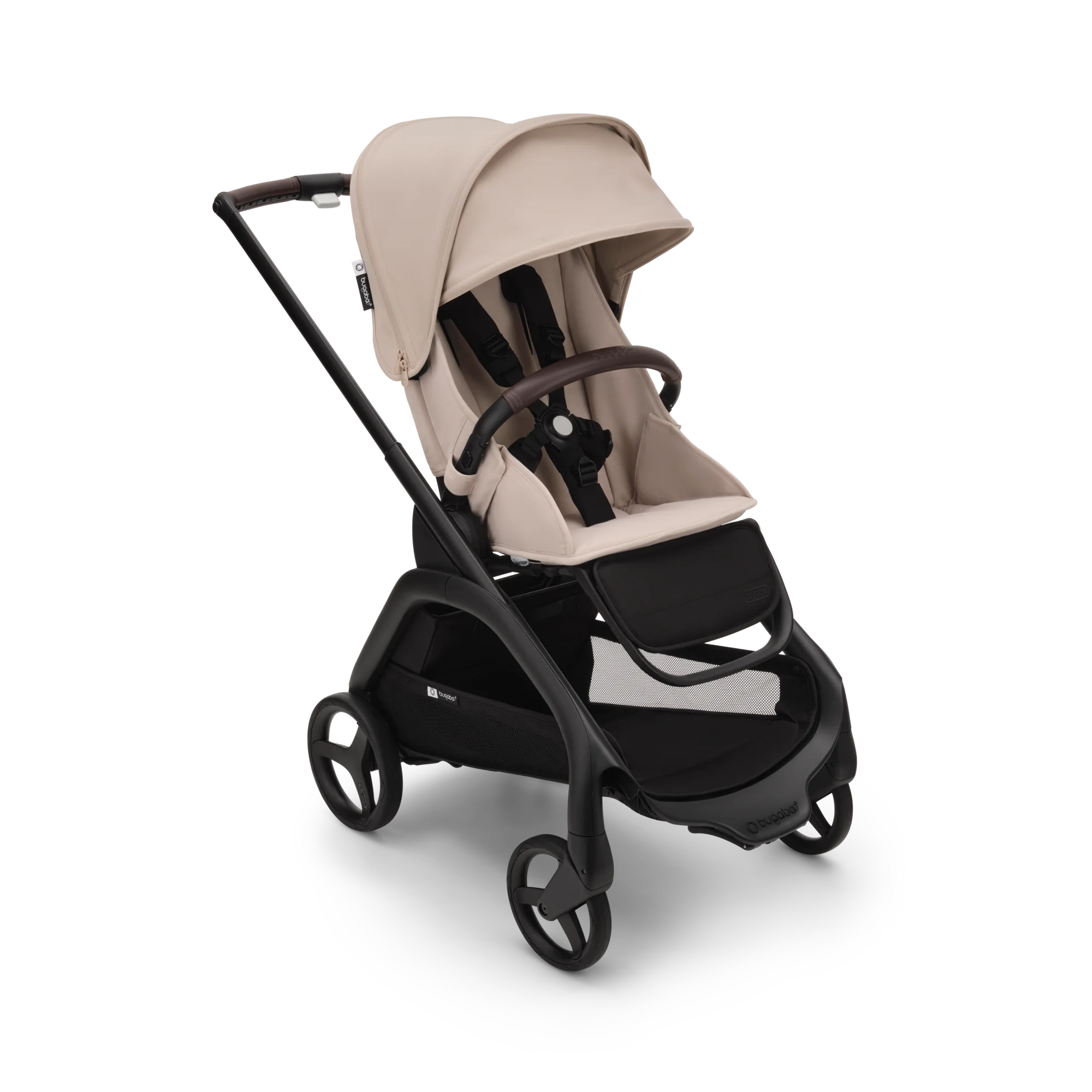
The fold is the argument. Bugaboo’s patented one-hand action collapses the Dragonfly with the seat still attached, and it stands on its own once folded, at 36 x 52 x 90 cm. That 36 cm depth is the number that matters. It is the difference between a pram that lives in the boot and one that lives against a wall in a hallway without blocking it. Nothing else in this price band publishes a footprint that reads like that while keeping a full-size reversible seat on the frame.
Weight is the second argument, with a caveat. Bugaboo’s base listing quotes 9.9 kg fully assembled with the seat fitted. Two of its own bundle listings quote 7.9 kg for the same stroller, which reads like a figure taken without the seat. Assume 9.9 kg is what you actually lift into a boot, because that is the configuration you will be folding.
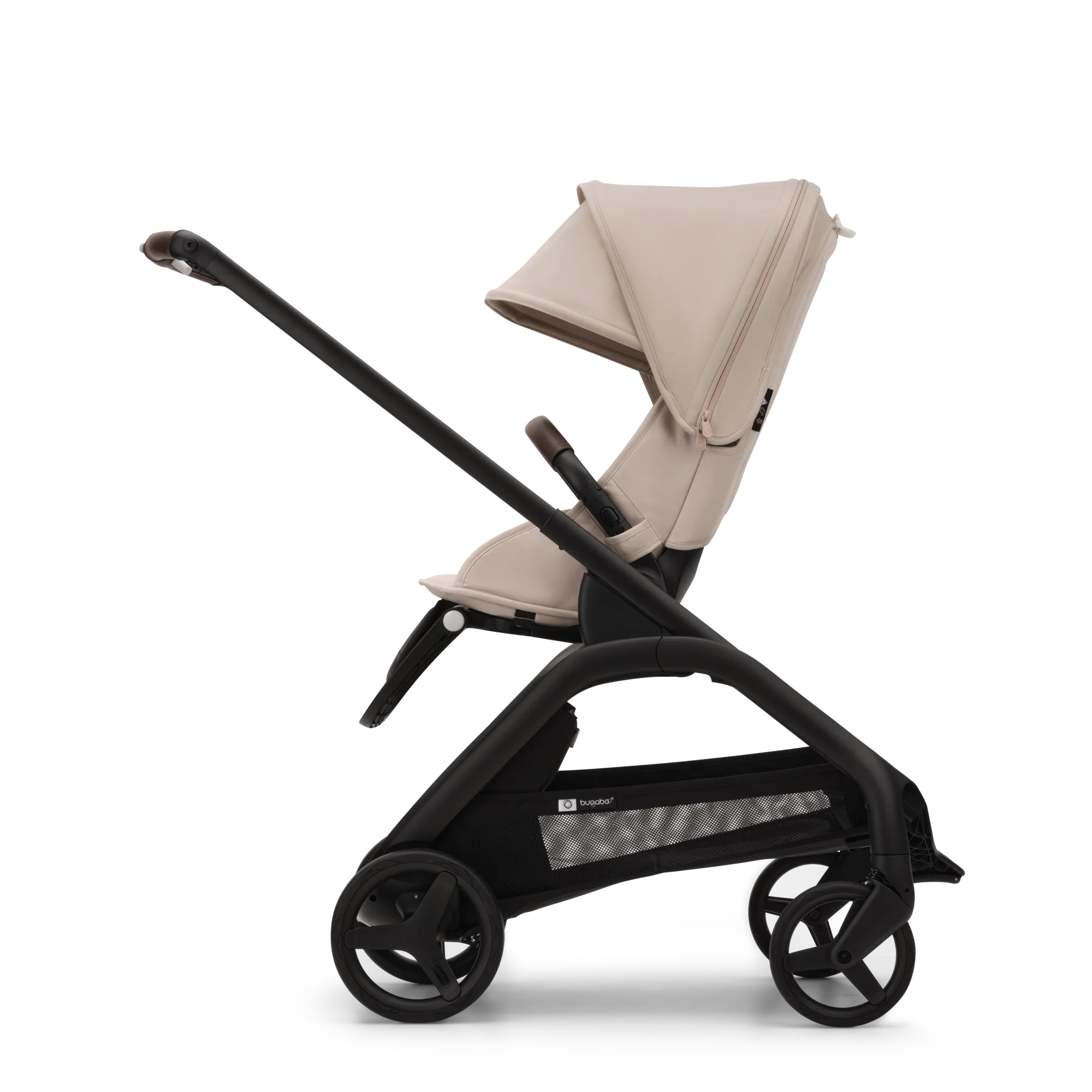
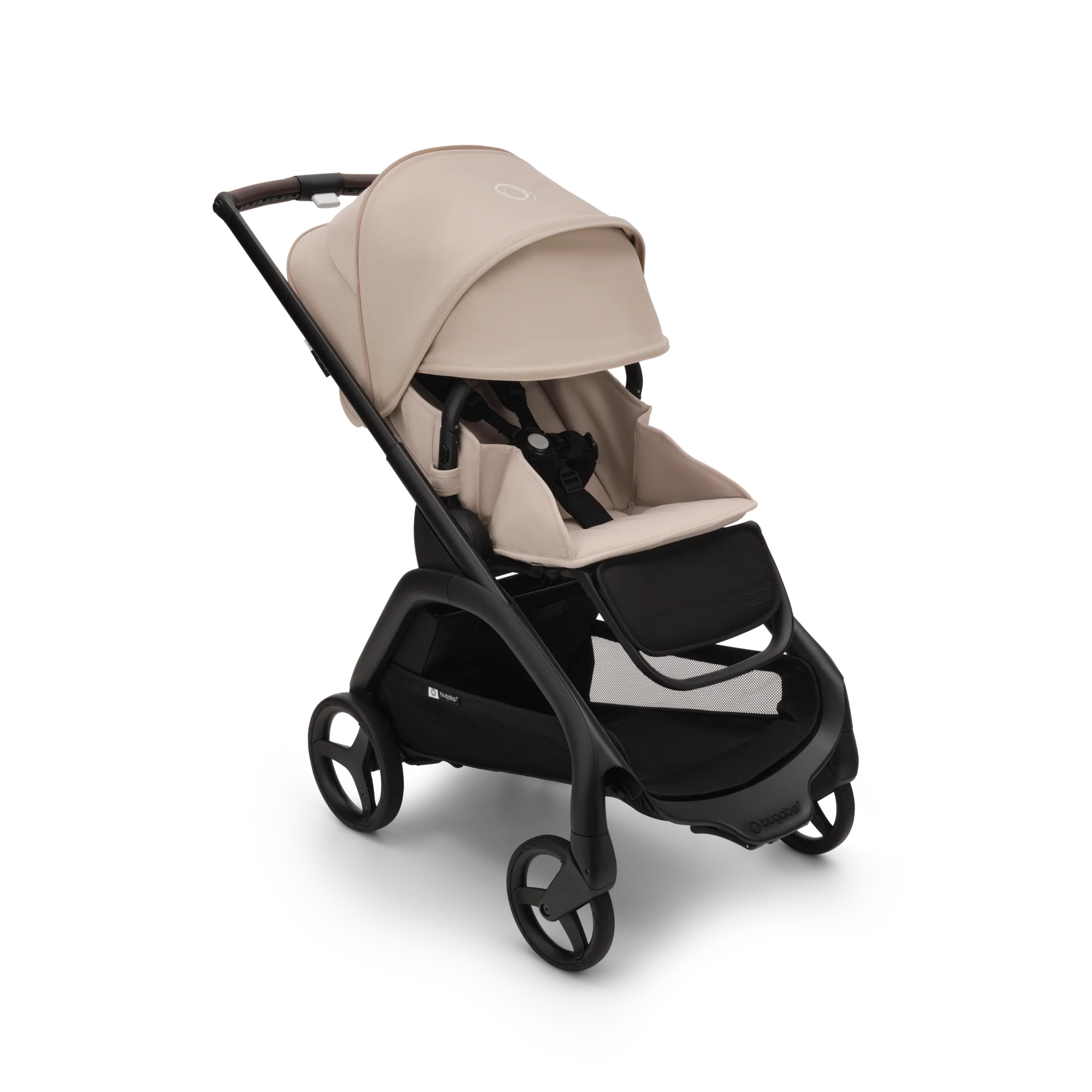
The rest of the seat spec is better than the price suggests. It is reversible and fully reclining, which is what makes the Dragonfly usable from birth without a bassinet, and it runs to 22 kg. The harness is a padded five-point. The canopy is an extendable UPF 50+ unit, included rather than optional, which is not a given at this money. Storage is 10 kg in the underseat basket plus a rear pocket. Full suspension is fitted across the range, and the fabric coatings are PFAS-free, with Bugaboo claiming a 21% CO2 reduction from mass-balanced bio-based materials. A carry strap is in the box.
At $979 you are buying the frame, the seat, the canopy and the fold. On the Bench Score that combination is enough for 9.0 on fold and footprint, the equal-highest mark in the category outside the Joolz Aer2.
The case against it
Versatility is where it gives ground, and it gives quite a lot of it. There is no bassinet included. There are no car seat adapters included. Both are dedicated Bugaboo parts sold separately, which is how a $979 pram becomes a $1,247 pram the moment you add the bassinet (Bugaboo Dragonfly Pram + Dragonfly Bassinet) or a $1,569 one once the Turtle capsule, ISOFIX base and adapters go on. The advertised entry price is real, but for most first-time buyers it is not the price they pay. Score it accordingly: conversion and versatility comes in at 7.5.
The running gear is the other soft spot. Bugaboo publishes “full suspension” and an “urban wheel design” and stops there. The base Dragonfly listing gives no tyre size and no construction detail. In a category where Thule quotes 16 inch air-filled tyres and Mountain Buggy quotes 10 inch aerotech tyres by name, silence is informative. The Dragonfly is a footpath and shopping-centre pram. Push and wheels scores 7.5, and that is a fair reflection of a spec sheet that declines to make a claim.
Build sits at 8.0. That is good rather than exceptional, and it is worth being clear about why: the Dragonfly is the entry Bugaboo, not the flagship. The Donkey 6 is quoted with a 60% recycled aluminium frame and scores 9.5 on build. You are getting the brand’s fold patent, not its best materials.
Australian parts and service scores 7.5, in line with the rest of the imported premium field. If after-sales support close to home is your first concern rather than your fourth, that number is beaten in this category by Australian-based brands, and it is beaten by a wide margin.
What it will actually cost you
The Dragonfly is sold up a ladder, and the rung you land on decides whether the pram is good value or ordinary value. The base Dragonfly Pram is $979. Add the bassinet and you are at $1,247. The Essential Pram Bundle, which is the bassinet plus a Dual Comfort seat liner, rain cover and a 500 ml cup holder, is $1,479. Go to a full travel system with the Bugaboo Turtle by Nuna capsule, its ISOFIX base and the Dragonfly adapters and it is $1,569.
Read those numbers against the field before you commit. At $1,479 the Essential bundle is $20 under the UPPAbaby Vista V3 Pram + Bassinet, which scores 9.0 and holds Best overall. At $1,569 the Dragonfly travel system is dearer than a Bugaboo Donkey 5 Pram Complete at $1,399, which scores 8.3 and includes bassinet and seat fabrics. The Dragonfly’s case is strongest at the bottom of its own ladder and weakest at the top. Only the base car earns its award.
How it compares
UPPAbaby Cruz V3 Pram, $999. Twenty dollars dearer and the better buy for most people. The Cruz V3 is suitable from birth with an included infant insert, carries a 13.6 kg basket against the Dragonfly’s 10 kg, runs never-flat tyres with a front wheel lock, and includes a rain shield and a bug shield rather than selling them to you. It takes the Best under $1,000 award on a Bench Score of 8.0. What you surrender is the fold: the Cruz is a one-piece compact fold but it does not publish anything like 36 cm of folded depth. Buy the Cruz unless the storage problem is the problem.
Bugaboo Dragonfly Plus Pram, $1,079. The in-house question worth asking, and the answer is no for newborn buyers. The Plus adds puncture-proof rubber wheels and a swivel front wheel lock, which is a genuine upgrade to the weakest part of the base car, but its seat is rated from 6 months, so a capsule or bassinet becomes compulsory rather than optional. It scores 7.7, below the base Dragonfly’s 7.9, entirely because of that. The Plus with bassinet and seat is listed at $1,599, which is Vista V3 money.
Joolz Aer2 Stroller + Aer2 Bassinet, $1,058. If compactness is the whole brief, this beats the Dragonfly at it. The Aer2 is 6.5 kg, folds to an IATA-compliant 44 x 53 x 23.5 cm, includes a 4 kg bassinet and a travel bag, and takes the Best for travel award at 7.7. It scores 9.5 on fold and footprint, the highest here. The trade is small wheels and an 8 kg basket, and it scores 6.5 on push and wheels, the lowest mark of any pram in this comparison. The Aer2 is a second pram or a travel pram. The Dragonfly can be your only one.
For context on the top of the table, see the full prams order of merit: the Dragonfly is not the category leader and does not pretend to be. The UPPAbaby Vista V3 Pram + Bassinet at $1,499 holds Best overall on a Bench Score of 9.0, with the bassinet in the box, a one-step self-standing fold and all-wheel suspension. It is $520 more and it earns it.
If the constraint is budget rather than boot space, the cheapest scoreable pram in the field is the Babyhood Air Compact Stroller at $499, which takes Best under $500 on 7.2. It is a lighter, simpler machine with EVA wheels and a lower build score, and it does not approach the Dragonfly’s frame quality. What it does have is an assisted auto fold, newborn recline, capsule compatibility and a 9.0 for Australian parts and service, the equal-best mark in the category. That is a different pram for a different problem, not a rival on merit.
Verdict
The Dragonfly is a specialist sold as an all-rounder. Judged as a city pram for a family with a storage constraint, it is very good: 36 x 52 x 90 cm folded, seat left attached, self-standing, one hand, from birth to 22 kg, and $979. Judged as a complete first pram it is incomplete, because the bassinet and the adapters are both extra and the wheel spec is unpublished. Work out which of those two prams you are buying before you look at the price. If it is the first, nothing else in the field folds this small with this much seat still bolted to it. If it is the second, the Cruz V3 at $999 does more for $20.
Bench Score 7.9 out of 10. Award: Best city fold.
| Criterion | Score |
|---|---|
| Conversion and versatility | 7.5 |
| Fold and footprint | 9.0 |
| Push and wheels | 7.5 |
| Build and materials | 8.0 |
| Australian parts and service | 7.5 |
| Overall | 7.9 |
Assessed on specification, 30 July 2026. No physical testing has been carried out. All figures are the manufacturers’ published specifications, and all prices are the lowest listed Australian retail as at 30 July 2026.
Disclosure: Babyhood is an agency client of The Baby Bench’s owner, Xpand Digital. Babyhood products are scored on the same published criteria as every other product in the field and are never ranked above products that outscore them.
Evidence record
Sources checked
Product specifications, claims and Australian pricing were checked against the following sources for this assessment. Prices and availability can change after publication.