
Sixteen bassinets and co-sleepers on sale in Australia, from a $127.99 travel frame to a $1,995 automated sleeper, assessed on published specification and lowest listed retail price. Nothing here has been hand-tested. Every number comes from the manufacturer’s own spec sheet, weighted so that safe-sleep design and airflow carry half the result.
The short version: the category winner costs $379, the best value costs $127.99, and the most expensive product in the field does not make the top eight.
Disclosure. Babyhood and its Kaylula brand are clients of Xpand Digital, which owns this publication. They are scored on the same published criteria as everything else and placed where the scores put them. Here that is fourth and eighth.
The order of merit
| # | Product | Bench Score | Price | Key spec |
|---|---|---|---|---|
| 1 | BabyRest Alfie2 Bedside Bassinet | 8.4 | $379 | Cites the 2024 Infant Sleep Products Standard |
| 2 | Snuzpod 5 Bedside Bassinet Sleeper | 8.2 | $449 | 3-in-1 bedside crib, 3D mesh mattress |
| 3 | ErgoPouch Easy Sleep Portable Bassinet V2 | 8.1 | $127.99 | Folds into an overhead-locker backpack |
| 4 | Babyhood Organic Breathe Eze Cosy Crib | 7.7 | $199 | Independently tested breathable fibre core |
| 5 | Cocoon Breeze Co Sleeper Bassinet | 7.6 | $379 | Full mesh panels, birth to 9kg |
| 6 | UPPAbaby SOMA Smart Bassinet | 7.6 | $929 | Five motions, 8-hour runtime |
| 7 | Britax Safe-n-Sound Aptana Bassinet | 7.5 | $299 | Full lie-flat with ventilated base |
| 8 | Kaylula Co Sleeper Cradle, Grey | 7.5 | $449 | Adjustable dropside, open side panels |
| 9 | BabyRest Swan Smart Electric Bassinet | 7.4 | $699 | Stir-responsive sensor, four heights |
| 10 | Thule Bassinet Soft Beige | 7.3 | $469.95 | Ventilated base, mattress and canopy |
Prices are as at 30 July 2026, lowest listed Australian retail.
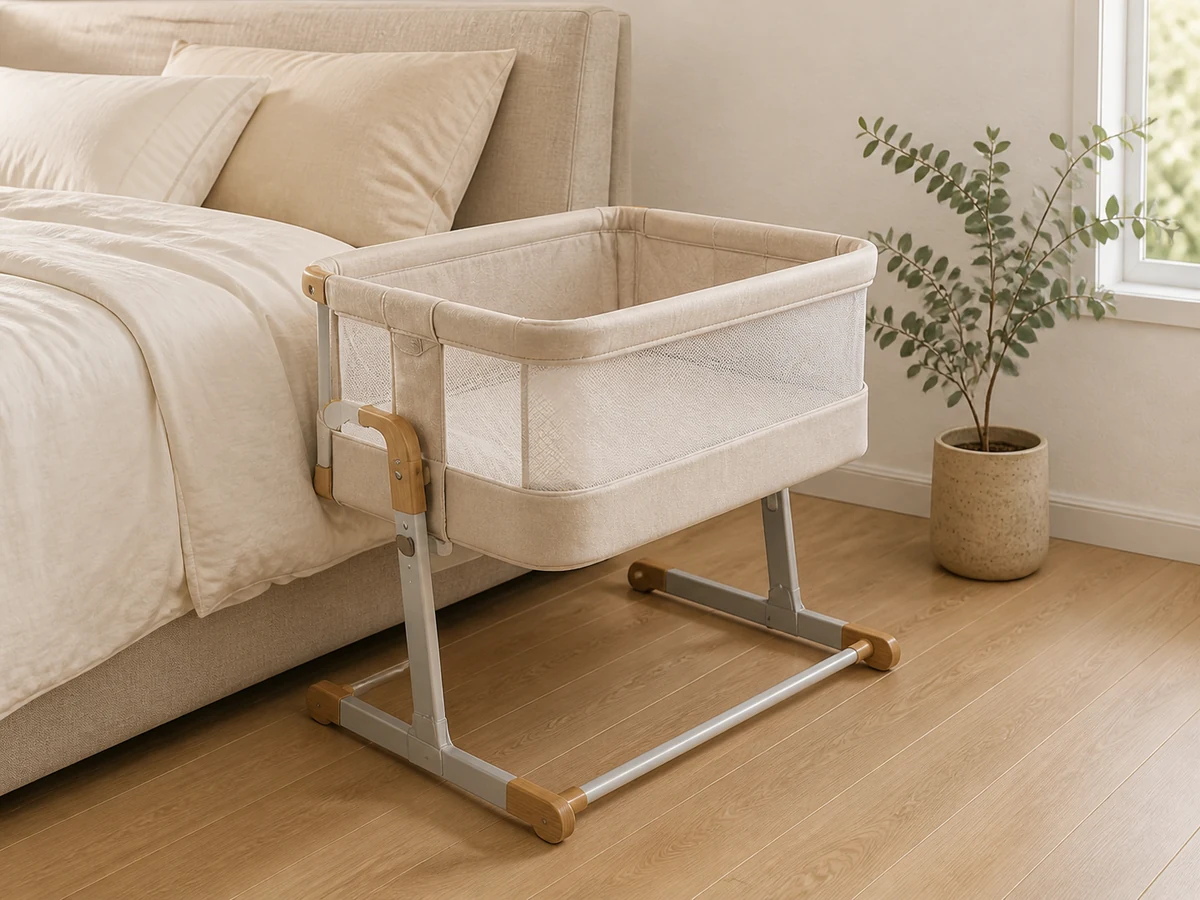
1. BabyRest Alfie2 Bedside Bassinet, Beige Walnut
$379. Award: best overall.
This is the only product in the field whose published specification names the Consumer Goods (Infant Sleep Products) Safety and Information Standards 2024. Everything else cites nothing, an unnamed standard, or an award. On a scoring system that puts 30% of the weight on safe-sleep design, that single line does most of the work.
The rest of the spec sheet holds up under it. All-round mesh sides, a mesh safety panel below the drop-down side, five height positions, and a firm mattress included rather than sold separately. It is rated from birth to 9kg or until your baby can sit unaided, ships with a travel bag, insect net and bed straps, and carries a 3-year warranty. Nothing in that list is exotic. The point is that it is all there at $379, in a category where all three products at $449 score lower. If you want one recommendation from this page, it is this one.
For. The only bassinet here citing the 2024 Australian standard, and the best-specified drop-side design at the price. Against. Plain next to the Snuzpod, and 9kg is a hard ceiling.
Bench Score 8.4. Sleep safety design 9.0, breathability and airflow 8.5, portability 7.5, build 8.0, value 8.5.
2. Snuzpod 5 Bedside Bassinet Sleeper
$449.
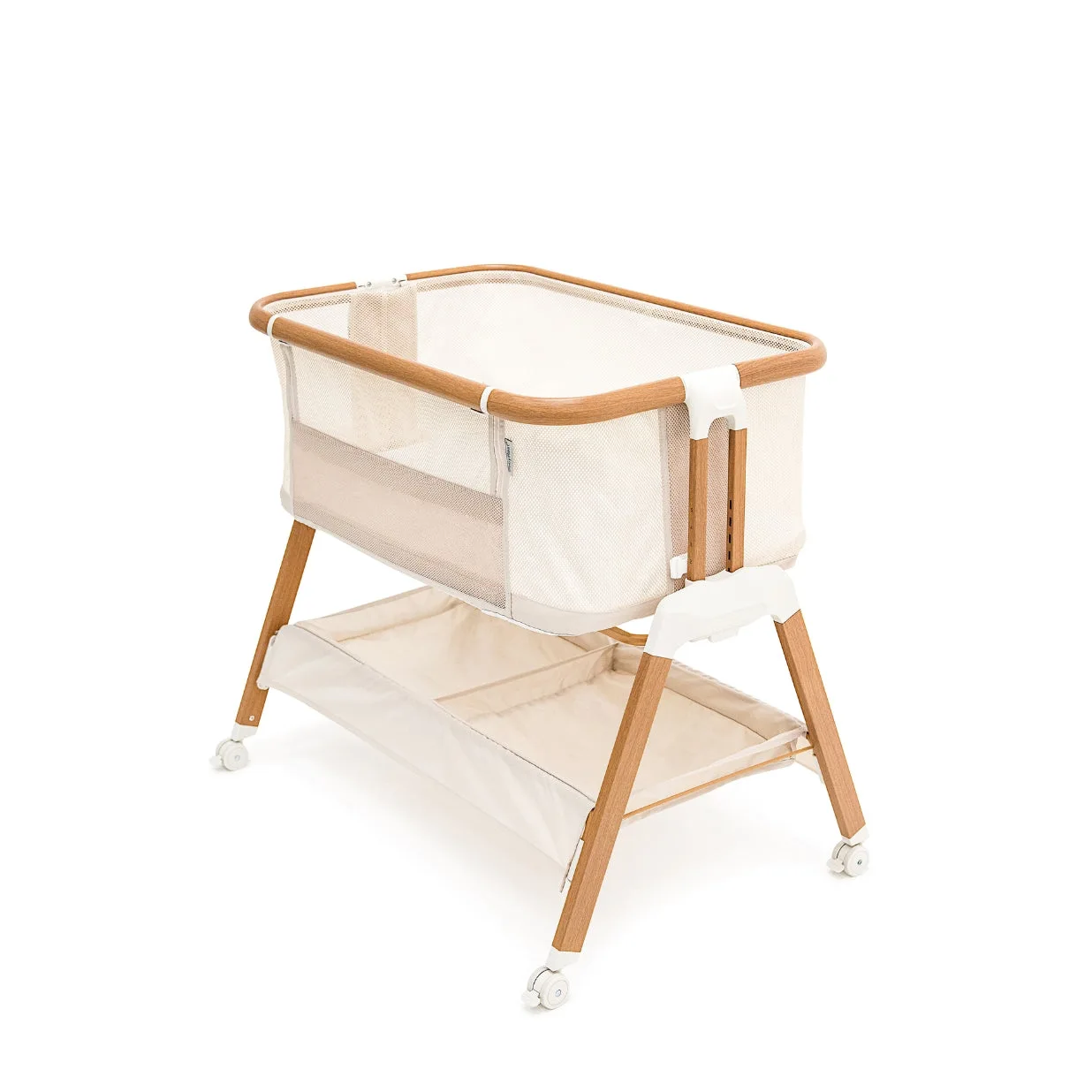
On paper the Snuzpod is the most complete premium bedside package in the field. It is a 3-in-1: bedside mode with a zip-down wall, a standalone crib, and a lift-off bassinet, on a rocking stand with removable wheels. Dual-view mesh windows and a 3D mesh mattress give it a 9.0 airflow score, second only to the UPPAbaby.
The wooden frame with removable washable fabrics is why it wins on furniture terms, and it is the one product here that will still look right in your bedroom at month six. The spec sheet says it is tested and certified to the latest standards without naming which, where BabyRest names the Australian 2024 instrument outright. That is $70 more for a slightly softer safety claim, and it is the whole difference between first and second.
For. Best airflow specification of any timber-framed bedside crib, and genuine 3-in-1 flexibility. Against. Certification language is vaguer than the winner’s, at a higher price.
Bench Score 8.2. Sleep safety design 8.5, breathability and airflow 9.0, portability 7.5, build 8.5, value 7.0.
3. ErgoPouch Easy Sleep Portable Bassinet V2, Ecru
$127.99. Award: best value.
Nothing else here is close on price, and very little is close on portability. A mesh body over a steel frame with high sides and a snap safety lock, a mosquito net, and a carry backpack the maker says fits in an overhead locker. Its 9.5 for portability is the highest in the category, and its 8.5 for value is matched only by the Alfie2.
Treat it as a second bassinet rather than a first. The build score of 6.5 is the lowest in the top ten, because a folding steel-and-mesh frame is not furniture and is not pretending to be. What it gives you is a known flat breathable sleep surface at your parents’ house or in a hotel room, for roughly a third of the price of the cheapest bedside crib here. The question is not how it compares to the Alfie2, but what you would otherwise have taken away for the weekend.
For. The cheapest safe-sleep frame here by a wide margin, and it packs into a backpack. Against. Lowest build score in the top ten, and no certification named on the spec sheet.
Bench Score 8.1. Sleep safety design 7.5, breathability and airflow 8.5, portability 9.5, build 6.5, value 8.5.
4. Babyhood Organic Breathe Eze Cosy Crib
$199.
Read the maker’s use case before the features, because it decides everything. Babyhood specifies this for supervised rest and play, not standalone overnight sleep. That caps the safety score at 7.0 however good the rest of it is, and it is why a well-made $199 product sits behind a $127.99 one.
The rest is well thought out. A fibre core to support airflow, which Babyhood says is independently tested. Certified organic cotton covers. A no-incline design, so your baby lies flat with no chin-to-chest risk. No ties or clips to become a strangulation hazard, and washable throughout. As a pod for daytime rest in the room you are already in, nothing else here does that job as well. As your only sleep space, it is the wrong product.
For. Independently tested breathable core, flat by design, and washable throughout at $199. Against. Specified for supervised rest, so you still need an overnight bassinet.
Bench Score 7.7. Sleep safety design 7.0, breathability and airflow 8.5, portability 8.5, build 7.0, value 8.0.
5. Cocoon Breeze Co Sleeper Bassinet
$379.
The Breeze matches the Alfie2 on price and gets close on hardware. Full mesh side panels, a drop-down co-sleeper side, adjustable heights, four lockable swivel wheels, a firm mattress, bed straps and a large storage basket. The one-button rocking mechanism is what the maker leads on, and it is a real convenience at 3am.
Two things hold it at 7.5 for safety. The spec sheet names no standard, and it offers a tilt incline for reflux and congestion. Inclined surfaces sit awkwardly against current flat-sleep guidance, and a feature that invites you to tilt the mattress is one you have to decide not to use. If you buy this, buy it flat.
For. Full mesh, one-button rocking and a complete accessory list at $379. Against. No certification named, and the tilt incline is a feature you should probably ignore.
Bench Score 7.6. Sleep safety design 7.5, breathability and airflow 8.5, portability 7.5, build 7.0, value 7.5.
6. UPPAbaby SOMA Smart Bassinet
$929. Award: best smart bassinet.
The SOMA has the best airflow specification in the field at 9.5, and it gets there honestly: a breathable mesh mattress rather than a foam slab, mesh sidewalls, and both the mattress and quilted cover fully washable. For a hot February in a room without air conditioning, that is the spec that matters most.
The automation is the reason for the price. Five motions across five speeds, four sleep sounds, an 8-hour runtime, and app-matched motion. It does what the Snoo does for $1,066 less, without locking the useful part behind a subscription. It is still $929 for something that lives in one room for six months, which is why value scores 5.5 and a technically excellent product finishes sixth.
For. Best-ventilated sleep surface here, with washable mesh and eight hours of motion. Against. $929 for six months of single-room use.
Bench Score 7.6. Sleep safety design 8.5, breathability and airflow 9.5, portability 5.0, build 8.5, value 5.5.
7. Britax Safe-n-Sound Aptana Bassinet
$299. Award: best stroller bassinet.
Judged as a carrycot, this is the strongest specification per dollar of any stroller bassinet here. Full lie-flat, firm mattress, mesh ventilation panel, ventilated base, XL UPF50+ canopy in water-resistant fabric, one-hand release, and a flat fold. It is rated from birth to roughly six months and 9kg. The catch is in the name: it attaches directly to the Aptana stroller with no adapters, which is convenient if you own that stroller and useless if you do not. Work out the chassis first, then the bassinet.
For. The best-specified stroller bassinet under $300, with a proper lie-flat surface. Against. Fits the Aptana stroller and nothing else.
Bench Score 7.5. Sleep safety design 7.5, breathability and airflow 8.0, portability 7.5, build 7.5, value 7.0.
8. Kaylula Co Sleeper Cradle, Grey
$449.
The Kaylula’s best idea is the adjustable dropside. It moves up or down depending on how close you want to be, and it keeps a firm barrier in every position rather than leaving an open edge. Babyhood’s instruction is to raise the side once your baby is asleep and you are going to bed, which is more sensible guidance than most makers publish. Open side panels give visibility and airflow, and adjustable legs set it to your mattress height.
Where it loses ground is the paperwork. The published specification names no sleep standard, and at $449 it sits $70 above the Alfie2, which does. Babyhood’s Australian parts and service operation is a real advantage over the imported brands here, but it does not close a certification gap at a higher price.
For. The dropside keeps a firm barrier at every height, with AU-based parts and service behind it. Against. $70 dearer than the category winner with a weaker certification story.
Bench Score 7.5. Sleep safety design 8.0, breathability and airflow 8.0, portability 7.0, build 7.0, value 7.0.
9. BabyRest Swan Smart Electric Bassinet
$699.
The Swan is the sensible way to buy automated settling. A Smart Motion sensor that starts the rocking when your baby stirs, three intensities, lullabies with adjustable volume, a remote, four heights, all-round mesh sides, and a Safer Sleep Tested mattress with two protectors. It is $1,296 less than the Snoo and covers the same job.
It is also $320 more than the Alfie2 from the same maker, for motion you may not need. Some babies settle on rocking and some do not, and you will not know which you have until the baby arrives. If the budget is fixed, buy the Alfie2 and keep the $320. If you want automated settling, look here rather than at the Snoo.
For. Automated stir-responsive settling and full mesh sides for a third of the Snoo’s price. Against. $320 more than the better-certified bassinet in the same range.
Bench Score 7.4. Sleep safety design 8.0, breathability and airflow 8.5, portability 5.5, build 7.5, value 6.5.
10. Thule Bassinet Soft Beige
$469.95.
The best-ventilated stroller bassinet in the field on the spec sheet: ventilated base, perforated removable mattress with a machine-washable cover, and an extendable ventilated UPF50+ canopy. The exterior is water-repellent rip-stop and it detaches quietly, which matters when your baby has finally gone down in the driveway.
Note what Thule does not claim. It is specified for infants aged 0 to 6 months for strolling, with no overnight sleep claim anywhere in the published text. As a pram accessory for naps on the move it is well made. As a bedroom bassinet you are outside what the maker will stand behind. It also needs model-specific adapters, so check yours before ordering.
For. Ventilated base, mattress and canopy, in weatherproof fabric. Against. No overnight sleep claim, and it needs the right chassis and adapters.
Bench Score 7.3. Sleep safety design 7.0, breathability and airflow 8.5, portability 7.5, build 8.0, value 6.0.
How we scored
Every product was assessed on its published Australian specification and lowest listed Australian retail price as at 30 July 2026. Nothing has been physically tested. Five criteria, weighted:
| Criterion | Weight | What it measures |
|---|---|---|
| Sleep safety design | 30% | Named standards, flat sleep surface, barrier design, mattress included, stated weight and age limits |
| Breathability and airflow | 20% | Mesh area, ventilated base and canopy, mattress construction, washability |
| Portability | 15% | Fold, carry provision, wheels, published weight where available |
| Build | 15% | Materials, frame, warranty, what is in the box |
| Value | 20% | Everything above, against price |
Weightings are published because that is where the editorial judgement sits. A bassinet is a sleep surface first, which is why half the score is safety and airflow. Where two products tie, the higher value sub-score ranks first, then the lower price. That is what separates fifth from sixth and seventh from eighth here.
Six further products fall outside the top ten: the Mamas & Papas Ocarro2 Bassinet at 7.3, the Snoo Smart Sleeper at 7.1, the Baby Studio Dream Glider at 6.9, the Babyhood Sandton Sleigh Cradle at 6.7, the Joolz Aer2 at 6.5 and the Joolz Hub2 at 5.9.
Buyer’s notes
Check what the maker actually claims. Read the sleep claim on the product page before anything else. “Approved for overnight sleep”, “supervised rest and play” and “for strolling” describe different products, and the price does not tell you which is which. The $199 Babyhood Cosy Crib is specified for supervised rest. The $469.95 Thule is specified for strolling. Neither is a bad product. Both are the wrong product if you were shopping for a bedroom bassinet.
One product here names the 2024 standard. The Consumer Goods (Infant Sleep Products) Safety and Information Standards 2024 applies in Australia, and of the sixteen products assessed, only the BabyRest Alfie2 states compliance in its published specification. That does not mean the others fail it. It means they do not say, and you would have to ask. Ask, and get the answer in writing before you pay.
Stroller bassinets are not a separate purchase. The Britax, Thule, Joolz and Mamas & Papas carrycots only fit their own chassis, and in most cases one named model of it. If you are still choosing a pram, choose the pram first. Buying a $469.95 bassinet and then finding it needs adapters for a chassis you do not own is the most expensive mistake available here.
Ignore the tilt, and remember six months. Several bassinets here offer an incline setting for reflux, the Cocoon Breeze among them, and current safe-sleep guidance is for a flat surface. Leave the mattress flat and take reflux to your maternal and child health nurse rather than to a wedge. Bear in mind too that almost everything here is rated to 9kg or six months, whichever comes first, and after that you are shopping for a cot. That is a short working life for a $929 or $1,995 purchase, and it is why value carries 20% of the score. The $379 winner and the $127.99 travel frame together cover the bedroom and the boot for less than half the price of one automated sleeper, and on these scores they do it better.
Assessed on specification, 30 July 2026.
Evidence record
Sources checked
Product specifications, claims and Australian pricing were checked against the following sources for this assessment. Prices and availability can change after publication.
Continue researching
Full reviews available
Read the detailed evidence, scoring and alternatives behind the products in this ranking.