
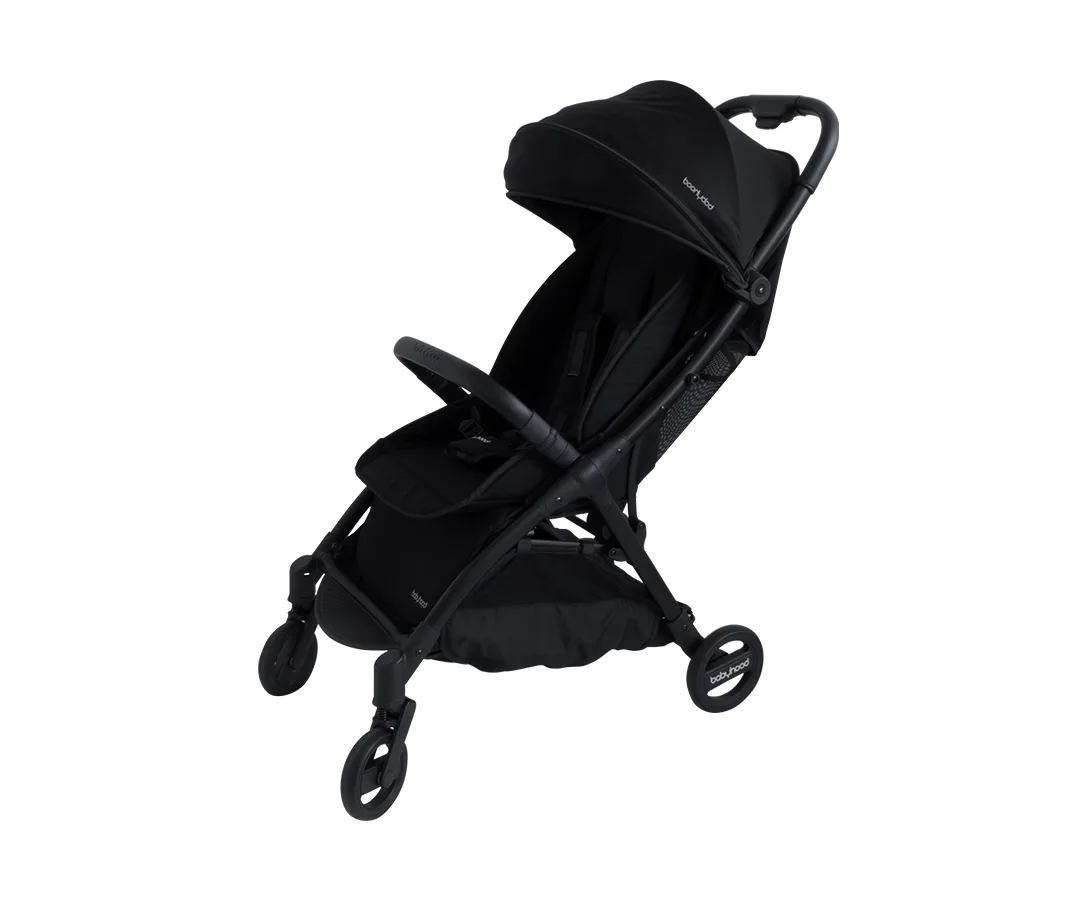
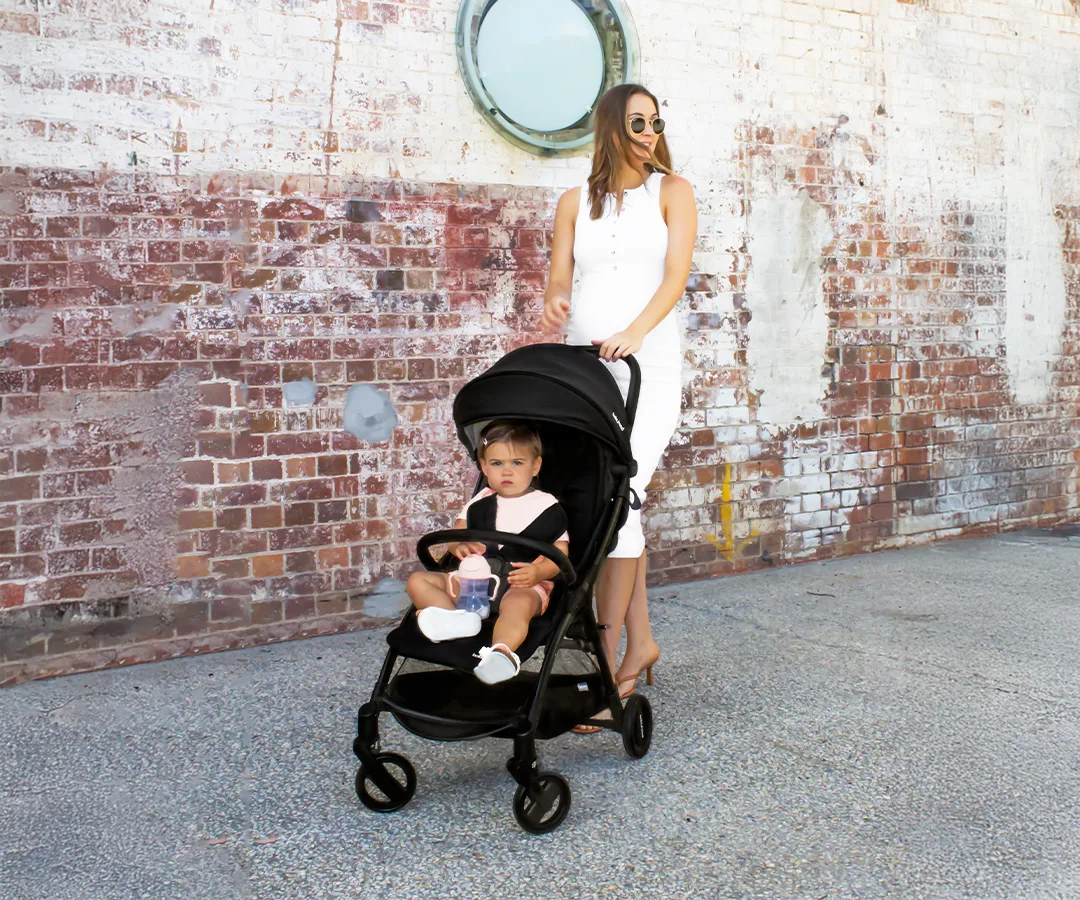
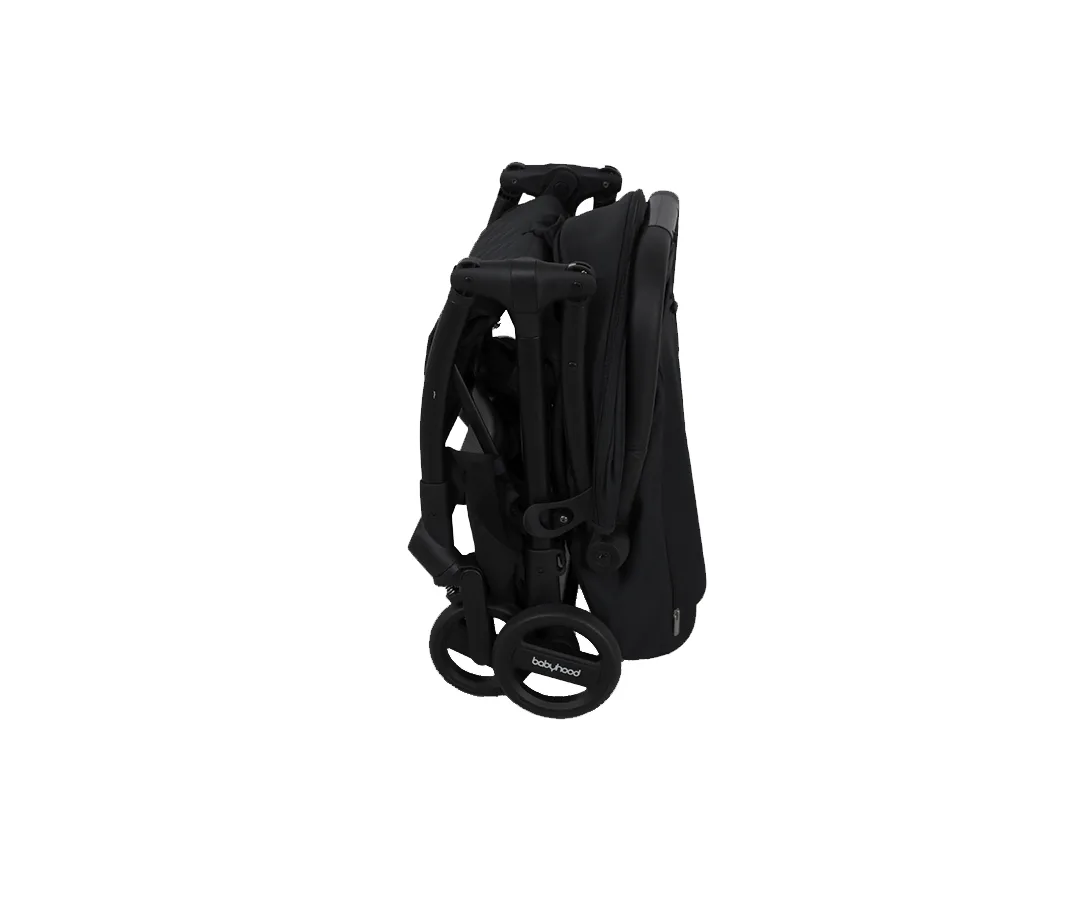
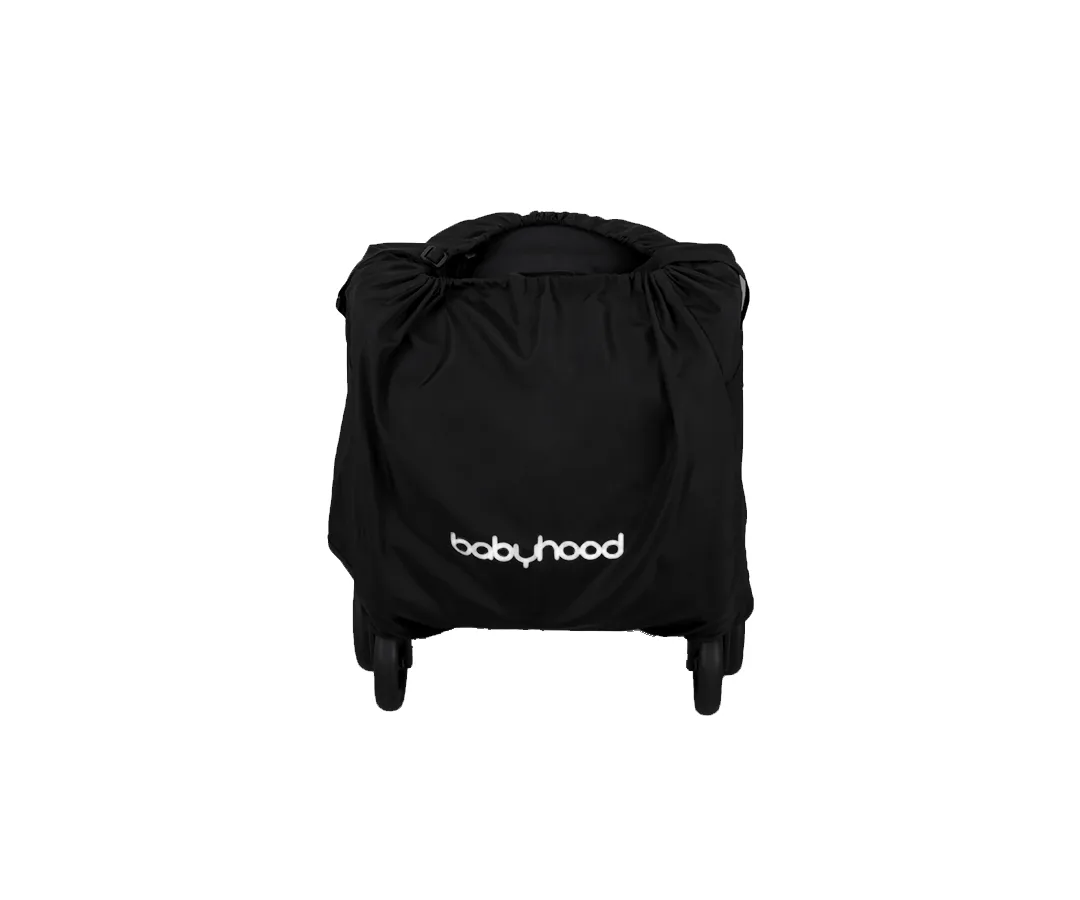
The Babyhood Air Compact is the rare $499 stroller whose strongest argument is not merely price. It weighs 8.1 kg, folds to a claimed 54 × 23 × 48 cm inside its travel bag, takes a child to 22 kg and supplies a lay-flat recline for the newborn stage. An assisted auto-fold, full-coverage sun drape and Australian repair pathway make it unusually complete for the bottom of the compact-pram market.
The limits are just as clear. The four wheels are high-density EVA, the basket is rated to only 2 kg and Babyhood describes the stroller as suitable for airline carry-on without claiming that every airline will accept it. This is a city, shopping-centre and holiday stroller—not a cheaper version of a full-size all-terrain pram.
Bench Score: 7.2 out of 10. This review assesses Babyhood’s published Australian specification. The Baby Bench has not pushed, folded, flown with or durability-tested this stroller.
Disclosure: Babyhood is an agency client of this publication’s owner, Xpand Digital. The relationship is declared because readers should never have to hunt for it. The Air Compact is scored below nine other prams in our full field and receives no advantage from the relationship.
The short answer
Buy the Air Compact if you want a second stroller for the car, travel or grandparents’ house; need genuine newborn recline rather than a six-month seat; and value being able to call an Australian service centre. At $499 it is one of the clearest budget buys in our pram field.
Skip it if you expect to carry groceries, walk broken footpaths every day or need a stroller whose cabin acceptance is guaranteed. A 2 kg basket fills quickly, small EVA wheels transmit more surface texture than rubber or air-filled tyres, and cabin limits belong to the airline—not the stroller maker.
Bench Score
| Criterion | Score |
|---|---|
| Conversion and versatility | 6.5 |
| Fold and footprint | 8.5 |
| Push and wheels | 6.0 |
| Build and materials | 6.5 |
| Australian parts and service | 9.0 |
| Overall Bench Score | 7.2 |
Key specifications
| Specification | Babyhood Air Compact |
|---|---|
| Price checked | $499 |
| Stroller weight | 8.1 kg |
| Open size | 41 × 70 × 105 cm |
| Folded in bag | 54 × 23 × 48 cm |
| Seat use | Lay-flat newborn mode; toddler mode to 22 kg |
| Wheels | Four high-density EVA wheels |
| Basket | 2 kg |
| Harness | Magnetic five-point harness |
| Sun protection | UPF 50+ hood and concealed sun drape |
| Travel system | Optional Maxi-Cosi capsule adaptors |
| Included | Carry bag, tether, bumper bar and basket |
| Standard cited | AS/NZS 2088:2013 |
| Warranty | 12 months; two years after registration under stated terms |
Specifications and price were checked on 11 August 2026.
The case for it
The newborn proposition is complete at the till
Many travel strollers advertise a from-birth frame while selling the fabric that actually holds a newborn separately. The Air Compact’s standard seat reclines flat, and Babyhood describes the recline mode for a newborn until the earlier of six months or sitting unassisted. An optional infant pod and Maxi-Cosi adaptors extend the setup, but neither is required to make the basic seat usable from birth.
That matters in a $499 product. A $100 insert or $300 bassinet changes the category it competes in. Here, the box contains the frame, seat, padded harness, wheels, sun drape, basket, bumper bar, handlebar, tether and travel bag. What is advertised is close to what leaves the shop.
The fold is genuinely compact
At 8.1 kg, the Air Compact is light enough for one-handed lifting even though the folding action itself is described as assisted rather than fully one-handed. The folded frame auto-locks and a tether lock secures it for travel. The packed 54 × 23 × 48 cm figure is useful because Babyhood publishes it with the bag, which is how it will actually enter a car or airport.
Babyhood says the dimensions sit within many IATA-aligned cabin allowances, then correctly tells buyers to check their own airline. Treat cabin carriage as a question to ask before every trip. Aircraft, fare class and enforcement vary; a stroller is not a boarding entitlement.
The Australian-climate details are unusually good
The UPF 50+ canopy and zip-out drape cover more of the seat than the small visors found on many compact strollers. A peekaboo mesh window adds ventilation, the textiles use a loose weave, and the seat cover can be removed for a cold gentle machine wash. Sunscreen, banana and airport carpet make washability more important than premium trim.
Australian service is the other differentiator. Babyhood lists service options in Brisbane, Melbourne and Sydney and asks other buyers to contact the Queensland team. That is why the stroller earns 9.0 for local parts and service—the strongest part of the ownership case.
The case against it
The wheels set the terrain limit
High-density EVA cannot puncture and keeps weight down, but it does not deform around broken surfaces like a rubber or air-filled tyre. Babyhood calls the system smooth on bumpy terrain without publishing wheel diameters or suspension travel. We score the hardware, not the adjective: 6.0 for push and wheels.
This is appropriate running gear for terminals, shops, paved paths and smooth neighbourhood footpaths. Daily gravel, tree roots and long park walks justify the larger wheels on a Mountain Buggy Swift or a full-size pram.
A 2 kg basket is a day-bag basket
Two kilograms is one of the smallest published basket limits in our field. A filled water bottle, wipes, spare clothes and a small nappy kit can consume most of it. The basket looks generous in photographs, but the rated load—not the visible volume—is what determines how much you should carry.
The published age wording needs care
The page describes a lay-flat newborn mode, while the specification table also says toddler mode begins from three months. Those statements are not inherently incompatible, but they mean the recline and harness configuration changes as the child develops. Follow the manual’s mode instructions rather than reading “newborn to 22 kg” as one unchanged setup.
How it compares
The Mountain Buggy Swift V4 costs more but publishes 10-inch aerotech tyres and an aircraft-grade aluminium frame; it is the better everyday walker. The Babybee Miles2 sits near the Air Compact on price and score, with an 8 kg basket but thinner running-gear disclosure. The Stokke YOYO3 and Joolz Aer2 fold smaller and use more sophisticated chassis hardware, but neither is a $499 purchase once newborn use is configured.
The Air Compact wins a narrow job: the least expensive complete compact stroller in our assessed field with a documented newborn recline and unusually strong Australian support. Read the full order in best prams under $800.
Who should buy it?
- Parents needing a compact second stroller that is usable from birth.
- Travellers who will confirm cabin limits before departure.
- Small-car households prioritising folded volume over basket capacity.
- Buyers who value Australian repairs and parts access.
- Families walking mainly on sealed, maintained surfaces.
Who should skip it?
- Heavy grocery carriers.
- Daily trail and rough-path walkers.
- Anyone expecting airline cabin acceptance without checking.
- Parents who want a bassinet rather than a lay-flat stroller seat.
- Buyers seeking full-size suspension and wheel hardware.
Verdict
The Air Compact is honest value when judged as a compact. It supplies a newborn-ready seat, an 8.1 kg frame, a measured travel-bag fold, substantial sun coverage, washable fabric and local support for $499. Those are the features most budget compact strollers make you assemble from add-ons.
The 2 kg basket and EVA wheels prevent a broader recommendation. Buy it to make cars, terminals and short paved outings easier. Do not buy it as a single piece of equipment expected to absorb every terrain and every grocery run for four years.
Bench Score: 7.2. Assessed on published specification, 11 August 2026. Primary source: Babyhood Air Compact Stroller 2025.
Disclosure: Babyhood is an agency client of The Baby Bench’s publisher, Xpand Digital. Client status does not buy a score, award or recommendation.
Evidence record
Sources checked
Product specifications, claims and Australian pricing were checked against the following sources for this assessment. Prices and availability can change after publication.