
The short answer
In a private car, a child under seven needs an approved restraint suited to their age and size. Under six months means rear-facing. From six months to under four years, the law generally allows rear-facing or forward-facing with an inbuilt harness. From four to under seven, it generally allows a forward-facing restraint with an inbuilt harness or an approved booster seat. Seven is a legal age threshold, not proof that an adult seatbelt fits your child.
This guide covers ordinary private-car travel. Taxis, rideshare vehicles, buses, vehicles with only one row of seats and medical exemptions can have different rules. Check the relevant authority below before a journey involving one of those situations. State and territory pages were checked on 29 September 2026.
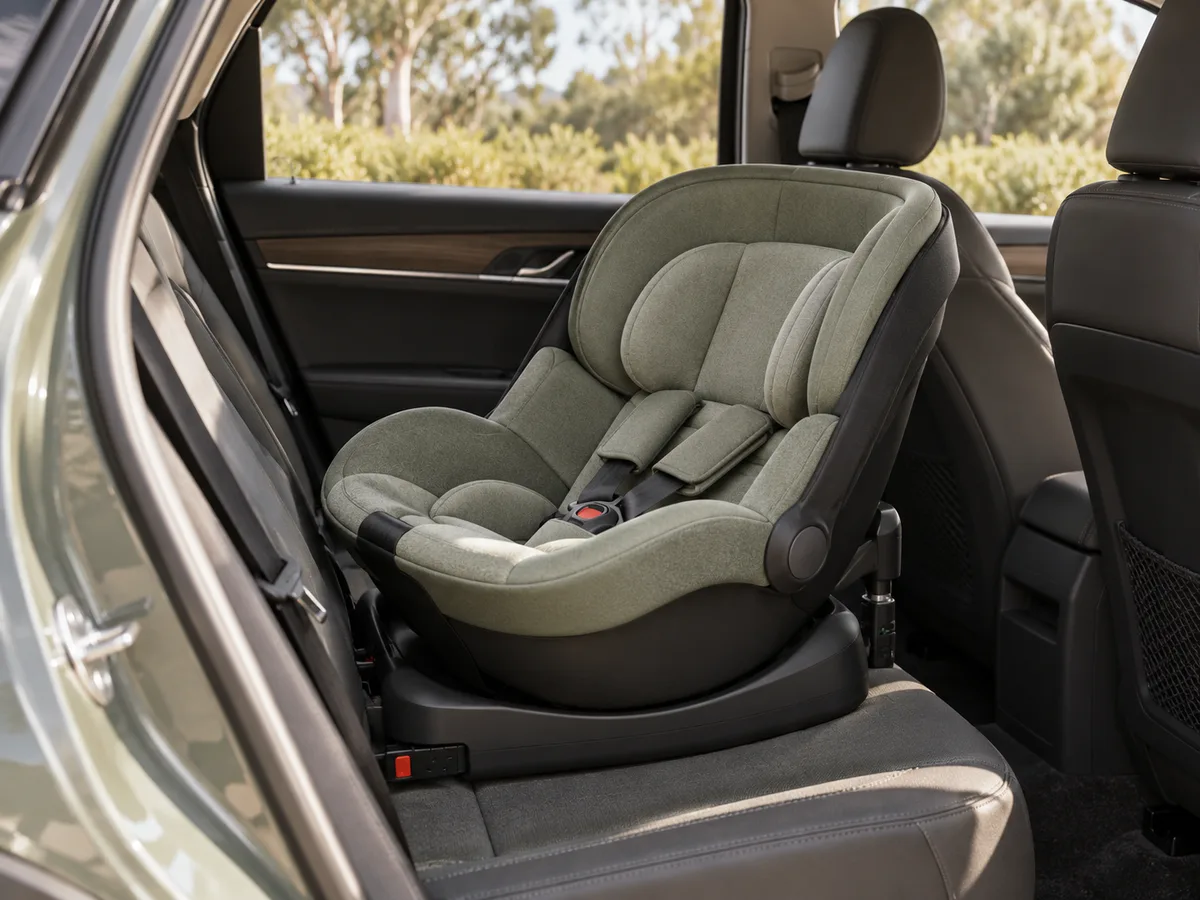
The age bands for private cars
| Child’s age | Usual minimum restraint requirement |
|---|---|
| Birth to under 6 months | Approved rear-facing child restraint. |
| 6 months to under 4 years | Approved rear-facing restraint, or approved forward-facing restraint with an inbuilt harness. |
| 4 years to under 7 years | Approved forward-facing restraint with an inbuilt harness, or approved booster seat used with the required seatbelt or harness. |
| 7 years and older | A suitable restraint or a correctly fitted adult seatbelt, according to the child’s size and the applicable road rules. |
The minimum age to change seat types is not a deadline to change. Transport Victoria advises keeping a child in their current restraint until they outgrow its size limit. The five-step seatbelt fit test is more useful than a seventh birthday when deciding whether the adult belt fits. The child’s back should stay against the seat; knees should bend over the edge; the sash should cross the middle of the shoulder; the lap belt should sit low over the hips; and the child should hold that position for the whole trip.
Check your state or territory
The age bands above are the common private-car baseline. The linked authority is the source for your jurisdiction’s current details, front-seat rules and exceptions.
| Where you drive | Official rule page | Particular point to check |
|---|---|---|
| New South Wales | NSW Government child car seats | NSW publishes specific taxi rules by the child’s age. |
| Victoria | Transport Victoria restraint rules | Rideshare follows private-car rules; taxi exemptions differ. |
| Queensland | Queensland child restraints | An overseas-purchased restraint is not acceptable unless it complies with AS/NZS 1754. |
| Western Australia | WA Road Safety Commission guidance | WA sets out the age bands and advises the five-step test before moving to an adult belt. |
| South Australia | SA seatbelts and child restraints | SA lists conditions for a child aged four to under seven to use a front seat. |
| Tasmania | Tasmanian child restraint guide | From seven to sixteen, the restraint or belt must still suit the child’s size. |
| Australian Capital Territory | ACT child restraints | ACT distinguishes taxis from rideshare and advises the five-step test. |
| Northern Territory | NT child car seats | NT explains its taxi, bus and single-row-vehicle exceptions. |
The National Transport Commission is reviewing child restraint rules. A proposal is not an enacted rule. If you are reading this well after the checked date, open your state or territory’s page before making a decision.
What makes a seat approved
An approved restraint must carry the relevant Australian/New Zealand Standard AS/NZS 1754 label. NSW’s consumer guidance explains the requirement. A seat sold overseas can look identical to an Australian model and still lack the required approval. Check the physical label, not just the retailer’s description.
Approval is only the first step. The restraint must suit the child’s height markers and the vehicle, be installed as instructed, and have its harness adjusted correctly. Tasmania’s guidance warns against moving to the next type too early. For a used seat, confirm its age, crash history, condition and instructions; do not assume an attractive second-hand listing is safe. If a seat does not fit the car or you are uncertain about installation, use a qualified child restraint fitter.
Where a child may sit
In a vehicle with two or more rows, a child under four generally cannot travel in the front row. A child aged four to under seven generally may use the front only under specified conditions involving the rear seats and still needs a suitable restraint. NSW, Victoria and South Australia publish the detail, including exceptions. A rear-facing restraint in front of an active passenger airbag is dangerous; check both manuals before using any single-row vehicle.
The buying decision
Choose the restraint that fits your child now, then check how long its height markers allow them to remain in it. Confirm approval, car compatibility, installation method, tether and anchorage requirements, and access to the manual and local support. Do not decide only from the age range on a product listing. A crash-test rating, where available, is separate from the legal AS/NZS approval and should not be inferred from a specification sheet.
The Baby Bench has not crash-tested or scored car seats. This guide makes no product safety ranking. For everyday gear beyond the car, our pram and stroller guide explains a different set of rules and use cases.
Checked 29 September 2026. Always use the current jurisdictional page and the exact restraint and vehicle instructions for your situation.
Evidence record
Sources checked
This guide draws on the following primary sources. Rules and guidance can change, so check the linked authority before relying on a detail.